Take a look at this story
Discover what to see on Kenya safaris with our complete Kenya wildlife guide!
No two African destinations are ever alike, and neither are their wild creatures. Kenya, often celebrated as the birthplace of safari, is a land where the drama of nature plays out daily against endless horizons. From lions sprawled across golden plains to elephants moving like ancient caravans across dusty earth, a wildlife safari in Kenya gives encounters as cinematic as they are unforgettable.
Its landscapes, grassland, forest, desert, and lake, are alive with diversity. Vast herds follow age-old migrations, predators patrol in silent stealth, and birds, in all their kaleidoscopic glory, color the skies. To travel here is not simply to watch wildlife in Kenya, but to feel yourself drawn into its rhythm: the quiet pause before a lion’s roar, the startling crash of a buffalo herd, the stillness before wildebeest plunge into crocodile-filled waters.
Whether it’s your first wildlife safari in Kenya or your fifth, the country never tells the same story twice. Here’s what you can expect on a journey into its untamed heart:

Powerful, social, and unapologetically regal, lions embody the essence of safari. Traveling in prides, these big cats are hunters of supreme skill and grace. At night, their deep-bellied roars reverberate through the bush, a sound as thrilling as it is primal. To see them, whether loping across open plains or resting in the shade, is to understand why they are called the kings of Africa.
The Masai Mara remains one of the best places in the world to observe lions, a reserve so rich in prides it became immortalized in the BBC’s Big Cat Diary. Watching cubs tumbling through the grass or lionesses working in perfect tandem on a hunt feels like stepping into the pages of natural history. For something extraordinary, Lake Nakuru reveals an unexpected twist: lions here have adapted to climbing trees. To see a full-grown male stretched along the bough of an acacia is to witness the wild’s infinite capacity for surprise.

Leopards are the elusive stars of Kenya’s wild stage, solitary, secretive, and dazzling in their rosette-spotted coats. Unlike lions, they prefer the hush of solitude, slipping silently between trees or melting into tall grasses. Their preferred perch is often high above the ground, where they lounge across branches with effortless elegance, their piercing eyes surveying the world below.
Patience and luck are required, but your best chances lie in the Masai Mara, where guides and trackers know the secret haunts of these shadowy cats. Samburu National Reserve also provides opportunities, its rugged terrain and acacia-dotted landscapes ideal for glimpsing leopards draped across branches at dawn or dusk.

Few creatures command such presence as elephants. As the world’s largest land mammals, they carry an air of dignity that is both calming and formidable. To watch a herd moving in slow procession across open plains is to feel a sense of ancient rhythm. Mothers guide their calves with tender patience; older matriarchs lead with memory and wisdom. Their trunks, with more than 40,000 muscles, are both tools and instruments of affection.
Amboseli National Park is iconic, with its herds often silhouetted against the snow-dusted peak of Mount Kilimanjaro, an image that defines the African safari. Tsavo East and Tsavo West are famed for their “red elephants,” dusted in the region’s ochre soil, their vibrant color almost surreal in the sun’s glow.
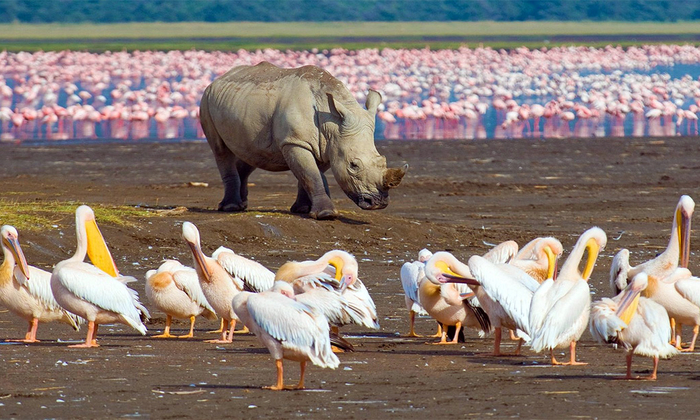
Among the rarest and most threatened of Kenya’s wildlife animals, rhinos represent both fragility and resilience. The black rhino, smaller and more temperamental, often travels alone; the larger, more placid white rhino is usually seen in groups. To encounter either in the wild is to be struck by their prehistoric aura, creatures seemingly sculpted from another age.
Ol Pejeta Conservancy is one of East Africa’s most important sanctuaries, home to a thriving population of black rhino and the last two northern white rhinos on Earth. Lake Nakuru has reliable sightings of white rhino, while the Masai Mara provides a rare opportunity to encounter black rhinos roaming free against vast horizons.

Sometimes underestimated, Cape buffalo are among the most dangerous animals in Africa, unpredictable, immensely strong, and fiercely protective of their herds. Their massive horns curve like battle armor, and their sheer numbers make them a formidable presence. Herds of hundreds move as one, while solitary bulls, notoriously grumpy, graze alone.
The Masai Mara is excellent for close encounters, herds often congregating near rivers and floodplains. Tsavo’s wide landscapes also host impressive populations, giving a sense of the raw, untamed scale of Africa’s wilderness.

Giraffes are safari surrealism: all elegance and angles, with necks that sweep into the treetops and legs that seem too long for balance. Their slow, deliberate movements hide the fact they can outrun predators at remarkable speed. Kenya is home to three subspecies, Masai, Rothschild’s, and reticulated, each with its own pattern, as unique as a fingerprint.
Lake Nakuru is a haven for Rothschild’s giraffe, their pale patches gleaming in the light. Samburu and Meru are the realm of reticulated giraffes, whose intricate patterns seem hand-painted. The Masai Mara and Amboseli showcase the Masai giraffe, striding elegantly across open plains beneath vast skies.

No animal is more visually iconic than the zebra, its black-and-white stripes a living work of art. To see them en masse, whether grazing peacefully or charging as part of the Great Migration, is a reminder that beauty and power often walk hand in hand. Kenya hosts both plains zebras and the rarer, larger Grevy’s zebra, each distinct in build and temperament.
Plains zebras are virtually everywhere, from Amboseli to the Mara. For Grevy’s zebra, head north to Samburu or Laikipia, where these endangered animals move across arid landscapes with stately grace. Their rarity makes every sighting feel like a privilege.

Often misunderstood, hyenas are essential to Kenya’s ecosystems. Their eerie, laughing calls echo across the savanna at night, while their powerful jaws recycle bone and carcass into nutrients for the soil. Watching them is both fascinating and unsettling, opportunists, yes, but also intelligent predators in their own right.
The Masai Mara offers plentiful sightings, especially around lion and leopard kills. Amboseli and Meru are also excellent places to watch their nocturnal dramas unfold, their cackling calls punctuating the night.

Graceful despite their massive size, eland are the largest of Kenya’s antelope. Both males and females bear spiraled horns, and their distinctive shoulder hump gives them a unique silhouette. In spite of their bulk, they are surprisingly agile, capable of leaping fences and clearing obstacles with ease.
Eland roam widely, but Nairobi National Park, just minutes from the capital, is one of the best places to spot them. The Masai Mara and Tsavo National Parks also support healthy populations, where they blend into herds of antelope and plains game.

Atop the Kogakuria Kopjes, Lamai Camp commands exceptional views of the Mara River Valley and Lamai Wedge. Its elevated setting makes it one of the best lodges to witness the Great Migration’s river crossings, where wildebeest and zebras surge through crocodile-infested waters in a primal spectacle.
The camp balances adventure and comfort beautifully. Explore on game drives, guided walks, or bush picnics. Between outings, cool off in natural rock pools, browse the library, or play board games. Suites feature outdoor showers and private decks with views that stretch to the horizon. Families are welcome, with Private Camp offering exclusive use for groups.
The Mara River is alive with pods, their snorts and splashes part of the soundtrack of the migration. Lake Naivasha is another hippo stronghold, where sightings can be enjoyed from boat trips or even lakeside lodges.

Ancient, armored, and patient, crocodiles are apex predators with a chilling presence. Nowhere is this more apparent than during the Great Migration, when thousands of wildebeest and zebra surge into Kenya’s rivers and crocodiles strike with deadly precision.
The Mara River is the most dramatic stage, its crossings etched into safari lore. Beyond the Mara, crocodiles thrive along the Tana River and in the turquoise waters of Lake Turkana, their silent vigilance a reminder of Africa’s oldest predators.

Also called “painted wolves”, African wild dogs are among Kenya’s most endangered predators. Their mottled coats are beautiful, but it’s their social dynamics that captivate: packs communicate with chirps and whistles, coordinating hunts with remarkable efficiency. To see them in the wild is a rare and sought-after privilege.
Laikipia has become a conservation stronghold, while Samburu gives chances to see them coursing over dry plains, their satellite-dish ears swiveling in unison.

No spectacle compares to the Great Migration, a thunderous movement of wildebeest and zebra across East Africa. Each year, the herds pour into Kenya’s Masai Mara from Tanzania’s Serengeti, creating one of the last great terrestrial migrations on Earth.
The Masai Mara is the stage for river crossings, typically from July to August, when the herds face crocodile-infested waters and predators on every side. Elsewhere, Amboseli and Meru host resident populations, offering more tranquil encounters year-round.

Kenya doesn’t just boast the Big Five. In the arid north, the Samburu Special Five, Grevy’s zebra, reticulated giraffe, Somali ostrich, Beisa oryx, and gerenu, showcase adaptations found nowhere else. These creatures are uniquely tailored to dry, rocky landscapes, offering a reminder of nature’s endless ingenuity.
Samburu National Reserve is the only place to reliably find all five, its dramatic escarpments and river valleys creating an unforgettable backdrop for such rare species.
The best time for a wildlife safari in Kenya is during the dry seasons: June through October and January through March. These months bring warm days, clear skies, and high visibility, with wildlife congregating around dwindling water sources.
That said, the so-called “green season”, April to May, and again in November and December, has its own allure. The landscapes are lush, birdlife flourishes, and lodges offer more favorable rates. While rains can disrupt travel, the trade-off is fewer crowds and a more intimate safari experience.
A safari is more than game drives, though dawn and dusk outings remain the heart of the experience. Kenya invites you to see its wildlife from new angles:
Each experience deepens the connection to Kenya’s wild heart, giving moments that stay with you long after you return home.
Kenya is not simply a destination; it’s a world alive with creatures that capture the imagination and stir the soul. From the thundering hooves of the migration to the stillness of a leopard at dusk, every encounter is part of a story that has been unfolding for millennia.
Whether you’re drawn to the Big Five, rare species found nowhere else, or the sheer wonder of migration, a wildlife safari in Kenya delivers moments that feel timeless. With FlashMcTours, you’ll experience it all, seamlessly, safely, and in style.


This 5-day safari to three of Kenya’s most iconic wildlife destinations promises plentiful wildlife, jaw-dropping scenery and the warm embrace of the Kenyan people.
Price From


Our 5-day Ol Pejeta and Samburu Safari showcases two of Kenya’s most interesting wildlife destinations. Firstly you’ll visit the privately owned Ol Pejeta Conserv
Price From


This ten day safari gives nature lovers an extended and diverse view of Kenya; its wildlife, its wonderful landscapes and its warm-hearted people. Given the countryâ€
Price From
This 5-day safari to three of Kenya’s most iconic wildlife destinations promises plentiful wildlife, jaw-dropping scenery and the warm embrace of the Kenyan people.
Price From
Our 5-day Ol Pejeta and Samburu Safari showcases two of Kenya’s most interesting wildlife destinations. Firstly you’ll visit the privately owned Ol Pejeta Conserv
Price From
This ten day safari gives nature lovers an extended and diverse view of Kenya; its wildlife, its wonderful landscapes and its warm-hearted people. Given the countryâ€
Price From
If you don't want to miss useful and interesting articles, leave us your email.
Also you will be the first to know about all discounts and offers.


Personalized service by travel experts with first-hand knowledge

Customizable tours to your preference

400+ 5-star TripAdvisor and Google reviews

Booking Security - Money - back guarantee & 24/7 support


Click one of our representatives below to chat on WhatsApp